




The Lakes Region real estate market is doing what it often does best: confusing people who are trying to make it sound simple.
At first glance, the numbers appear to tell one story.
Sales are down.
Prices are up.
Days on market are longer.
Inventory is still tight in some places, wildly ambitious in others, and waterfront buyers continue to behave as if Lake Winnipesaukee has quietly become its own currency.
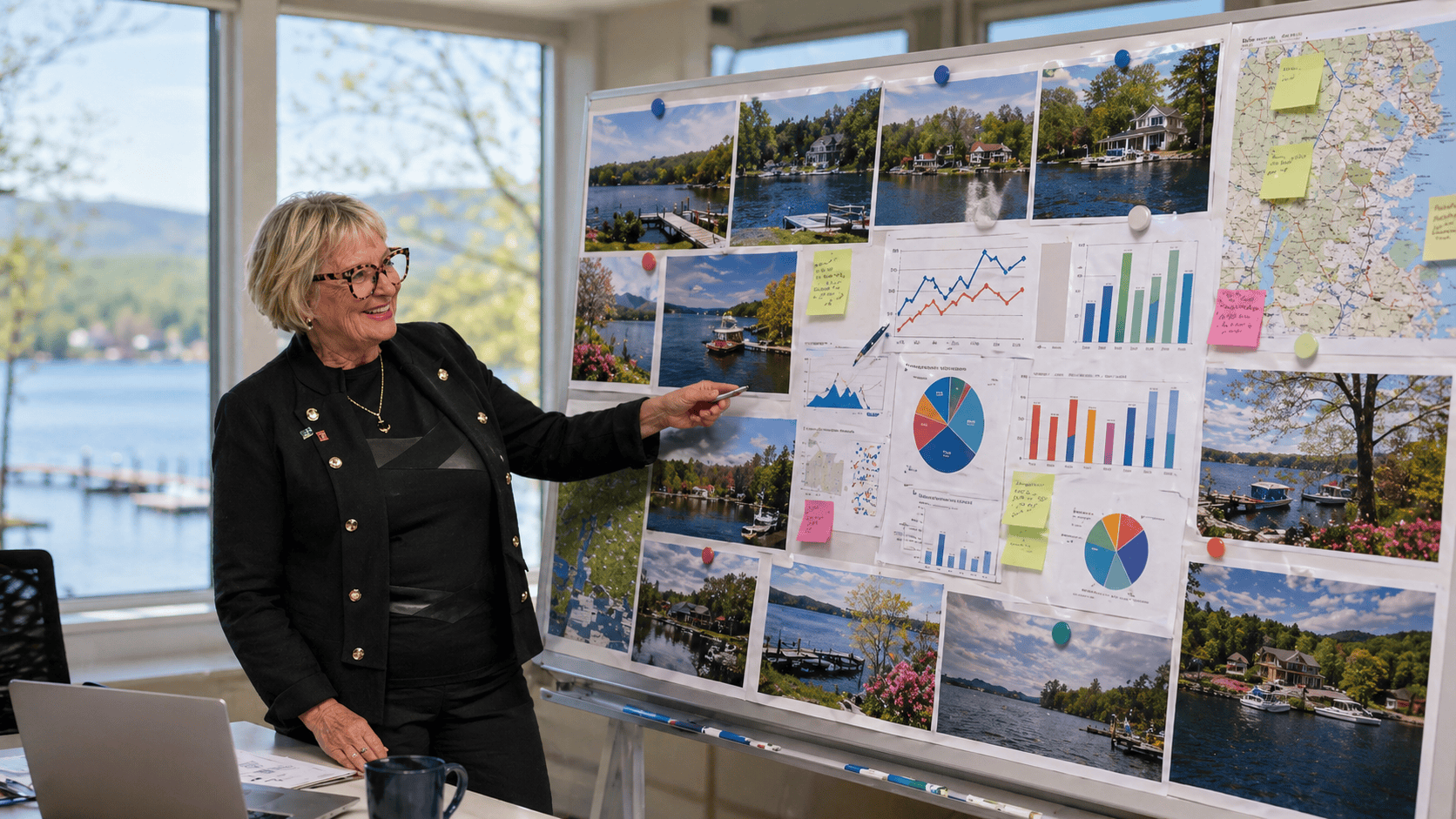
So, is the market slowing?
Yes.
Is it weak?
Not exactly.
Is it behaving like a polite, predictable spreadsheet?
Absolutely not. This is real estate, not a toaster manual.
The Big Picture: Fewer Sales, Higher Prices, Longer Decisions
Looking at Lakes Region residential activity across 25 towns and cities from January 1 through April 17, 2026, single-family home sales were lower than the same period in 2025.
For that 2026 period, there were 234 single-family home sales with a total sales volume of approximately $169.8 million. The median sale price was $513,750, and the median days on market was 34.
During the same period in 2025, there were 269 sales with a total volume of approximately $178.8 million. The median sale price was $479,000, and median days on market was 26.
So, in plain English:
Fewer homes sold.
Total sales volume dipped.
Median prices rose.
Homes took longer to sell.
That is not a collapsing market. That is a market becoming more selective.
Buyers are still here, but they are looking harder, asking better questions, and showing less enthusiasm for paying premium prices for homes that arrive on the market with 2006 countertops and a seller’s dream journal attached.
The Market Is Not One Market
This is where people often go wrong.
They say “the Lakes Region market” as though Alton, Meredith, Wolfeboro, Gilford, Moultonborough, Laconia, Belmont, Center Harbor, Tuftonboro, Sanbornton, and Bristol are all marching in a tidy little line.
They are not.
A waterfront home on Winnipesaukee is not competing with a village colonial in Wolfeboro in the same way a Belmont ranch is not competing with a luxury second home in Meredith. A condo in Gilford is not the same market as a private road property with lake access and association rules longer than some novellas.
This region has layers.
Waterfront.
Water access.
Island property.
Primary homes.
Second homes.
Condos.
Legacy properties.
Downsizing properties.
Short-term-rental-sensitive properties.
Homes that need work.
Homes that pretend they do not need work, which is always adorable.
The numbers matter, but the context matters more.
Winnipesaukee Is Still Winnipesaukee
Lake Winnipesaukee continues to operate by its own gravitational rules.
From January 1 through April 17, 2026, there were 12 closed single-family home sales on Lake Winnipesaukee, totaling approximately $32.99 million in volume. The median sale price was $2,223,750, with a median days on market of 72.
For the same period in 2025, there were 14 sales, totaling approximately $35.39 million. The median sale price was $2,157,500, with 65 median days on market.
So again, fewer sales, slightly higher median price, longer marketing time.
That tells us something important.
Winnipesaukee buyers are still willing to pay for the right property. But “right” is doing a lot of work in that sentence.
Location matters. Frontage matters. Exposure matters. Docking matters. Privacy matters. Condition matters. Access matters. Town matters. View matters. And, yes, whether the house feels like a legacy property or a deferred-maintenance museum matters too.
As of April 17, 2026, there were reportedly 32 Winnipesaukee waterfront homes for sale with a median asking price of $3,795,000.
That is a very different number from the median closed sale price.
Translation: sellers are aiming high. Buyers are still buying, but they are not necessarily applauding every price tag placed in front of them like trained seals.
Condos Are Telling Their Own Story
The condo market is also worth watching, especially because condos often appeal to buyers who want lower maintenance, second-home flexibility, or a foothold in the Lakes Region without signing up for the full “I now own three ladders and a dock permit problem” lifestyle.
From January 1 through April 17, 2026, there were 64 condo sales across the 25-town Lakes Region snapshot, totaling approximately $32.82 million in sales volume. The median condo sale price was $464,500, and median days on market was 36.
For the same period in 2025, there were 73 condo sales, with volume of approximately $33.72 million. The median sale price was $405,000, and median days on market was 15.
That is quite a shift.
Condo sales were down, prices were up, and days on market more than doubled.
This does not mean buyers stopped wanting condos. It means they are weighing price, fees, location, rules, amenities, insurance, rental restrictions, and overall value more carefully.
Which they should.
A condo is not just a unit. It is a financial ecosystem with bylaws.
Thrilling, I know. Try putting that on a throw pillow.
Active Inventory: The Asking Price Gap
As of April 17, 2026, there were reportedly 308 single-family homes for sale across the 25-town Lakes Region snapshot, with a median asking price of $699,900.
That is meaningfully higher than the median closed sale price for the period.
There were also reportedly 105 condos for sale, with a median asking price of $479,900 and median days on market of 105.
That last number deserves attention.
When active inventory is sitting longer than recently closed properties, it may suggest a pricing gap, a condition gap, a presentation gap, or simply that buyers and sellers are still negotiating the emotional fallout from the last few years of real estate madness.
The pandemic market taught some sellers that anything with walls and a roof could attract multiple offers by lunchtime.
That was not a market. That was a fever.
We are now in a more discerning environment.
Better homes, better pricing, better preparation, and better marketing matter again.
Frankly, they always did. The market just got loud enough for a few years that some people forgot.
Why Demand Remains Strong
The Lakes Region remains a powerful draw.
Some buyers are relocating from other states. Some are moving closer to family. Some are retiring or semi-retiring. Some discovered during the pandemic that if they could work from anywhere, “anywhere” might as well include a lake, a mountain view, a decent cup of coffee, and fewer daily arguments with traffic.
New Hampshire continues to attract people from surrounding states, especially Massachusetts. The Lakes Region, in particular, benefits from lifestyle migration: second-home owners becoming full-time residents, remote workers seeking space, retirees looking for quality of life, and families wanting a place that feels less frantic.
But there is a challenge baked into that opportunity.
Rising prices and limited housing supply make it harder for younger workers, service workers, first-time buyers, and local families to stay in the communities that make this region function.
That matters.
A healthy real estate market is not just measured by luxury sales and waterfront records. It is also measured by whether teachers, nurses, tradespeople, restaurant workers, young families, and local employees can live anywhere near the towns they serve.
The Lakes Region cannot thrive on charm alone.
Charm is lovely. It does not plow the roads, staff the schools, fix the docks, or pour the coffee.
What This Means for Sellers
For sellers, the message is simple but not always comfortable:
The market is still strong, but it is not automatic.
Pricing matters. Presentation matters. Strategy matters. Local knowledge matters.
If your property is special, we need to show why. If it has issues, we need to manage them before buyers turn them into negotiation confetti. If it sits in a niche market — waterfront, island, association, village, acreage, antique, seasonal, condo, or estate — it needs a marketing plan that understands the niche, not one that throws it online and hopes Zillow performs a miracle.
Hope is not a strategy.
It is barely a beverage.
What This Means for Buyers
For buyers, this market requires patience, clarity, and due diligence.
There are opportunities, but they are not always obvious. A property that has been sitting may be overpriced, misunderstood, poorly presented, or genuinely flawed. Sometimes it is all four, because real estate likes to keep us humble.
Buyers need to understand more than the list price.
They need to understand town, taxes, septic, wells, road maintenance, association rules, shoreline regulations, access, rental restrictions, inspection risk, insurance concerns, and resale appeal.
Especially here.
In the Lakes Region, you are not just buying a house.
You may also be buying a dock conversation, a private road agreement, a beach right, a septic setback, a view easement, a plow arrangement, and a neighbor named Bob who knows exactly where the property line is because his grandfather told him in 1972.
Proceed accordingly.
The Bottom Line
The Lakes Region market is not weak.
It is shifting.
Sales volume is softer in some segments. Prices remain resilient. Days on market are rising. Active listings are asking for more than recent closed sales may justify. Waterfront remains powerful but not immune to buyer scrutiny. Condos are moving, but more slowly. And the region’s long-term appeal remains firmly intact.
This is a market that rewards preparation, local intelligence, and honest strategy.
For sellers, that means pricing with evidence, not nostalgia.
For buyers, it means asking better questions before falling in love with the view.
And for everyone watching the Lakes Region this spring, one thing is clear:
The market is still very much alive.
It is just no longer wearing a party hat and handing out offers like Halloween candy.
Data note: Market figures referenced here are based on reported PrimeMLS data snapshots for the Lakes Region and Lake Winnipesaukee through April 17, 2026. All figures should be verified against current MLS data before making real estate decisions, because real estate data changes quickly, and occasionally likes to move the furniture when no one is looking.




.png)


Footer Social Links