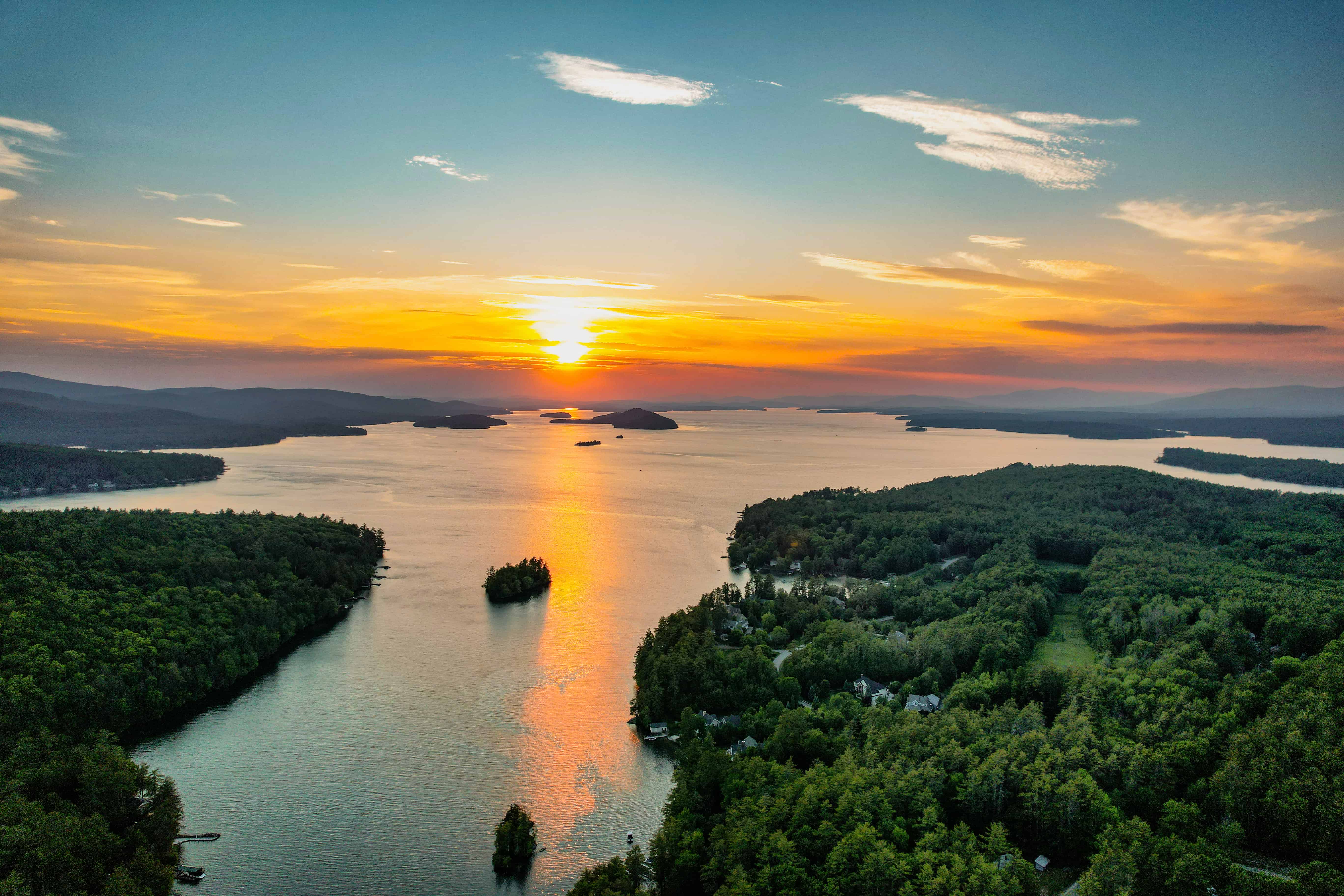




What boaters, buyers, and sellers should know before falling in love with “lake access”
There are two very different ways to experience New Hampshire’s Lakes Region.
You can drive around it.
Or you can arrive by water.
And once you have pulled up to a town dock in Meredith, walked from the Wolfeboro waterfront to lunch, tied up at Weirs Beach for ice cream, or slipped into Alton Bay on a summer afternoon, you begin to understand something important about lake life in New Hampshire.
The dock is not just a dock.
It is a front door.
For many buyers, especially those looking at waterfront, island, or boat-access properties, public docks and lake access are not minor details. They shape how you use the lake, where you shop, where guests meet you, where you launch, where you stop for lunch, and whether your “perfect lake home” actually works for the way you intend to live.
As with most things in real estate, the glossy version is simple.
“Lake access!”
Lovely. Also useless, unless someone explains what kind.
Public docks, public launches, town beaches, resident-only parking, short-term tie-up rules, boat-length limits, no-overnight restrictions, seasonal hours, private association docks, shared beaches, deeded rights, moorings, and waitlists are all part of the real picture.
So here is a practical guide to public docks, town landings, boat launches, and private association access around the major lakes of New Hampshire’s Lakes Region.
One important note before anyone starts sharpening an oar: public docking rules change. Towns update ordinances. Dock projects happen. Parking rules can be resident-only. Launch fees may change. Before making a day of it, check the town, state, marina, or association source directly.
That said, this gives you the map behind the marketing.
Lake Winnipesaukee: The Main Stage
Lake Winnipesaukee is the big one. It is New Hampshire’s largest lake, the centerpiece of the Lakes Region, and the place where public docks matter most because the lake is ringed by towns that function almost like small ports.
The Lake Winnipesaukee public access map identifies a wide range of access points around the lake, including boat launches, town docks, beaches, parks, landings, and public waterfront sites.
This is why Winnipesaukee buyers need more than “waterfront.”
They need context.
A property on Winnipesaukee can mean walk-to-town convenience, island logistics, quiet cove living, marina dependency, private association access, deeded dock rights, or a long boat ride to groceries.
Same lake.
Very different life.
Weirs Beach Public Docks, Laconia
Weirs Beach is one of the best-known public docking destinations on Lake Winnipesaukee. It is not subtle. It is not sleepy. It is not pretending to be a Zen retreat in linen trousers.
It is boardwalk, beach, arcades, food, people, boats, summer noise, and full-on Lakes Region nostalgia.
The Weirs Beach public docks allow boaters to arrive directly by water and walk to Weirs Beach, the boardwalk, restaurants, ice cream, the Winnipesaukee Scenic Railroad, Endicott Rock Park, Mount Washington Cruises, and seasonal entertainment.
Docking rules matter here. Weirs Beach information notes that overnight docking is prohibited between 2 a.m. and 6 a.m., and public docking between 6 a.m. and 9 p.m. is generally limited to three hours. Laconia’s municipal code also includes specific regulations for the Weirs wharves and docking use.
Best for: day trips, visitors, food, beach access, classic summer activity
Watch for: crowds, docking limits, commercial-use rules, peak-season traffic
Meredith Town Docks
Meredith is one of the most useful boat-access towns on Winnipesaukee. It has restaurants, shops, hotels, parks, the sculpture walk, coffee, ice cream, and that dangerous “I only came for lunch but now I’m browsing real estate” effect.
The Meredith town docks and boat launch rules are very specific. Meredith states that town docks have a three-hour docking limit from 7 a.m. to midnight, with no overnight docking. The town also notes that the aluminum dock at Hesky Park is for temporary loading and unloading only, and that the Hesky Park ramp has a maximum combined boat and trailer length of 30 feet.
Meredith works especially well for buyers who want waterfront lifestyle without feeling stranded from civilization. You can arrive by boat and still walk to dinner, shopping, lodging, events, and errands.
That is not just convenience.
That is lifestyle value.
Best for: dining, shopping, guests, walkable lake-town living
Watch for: docking time limits, parking pressure, launch rules, summer congestion
Center Harbor Public Docks
Center Harbor is quieter than Meredith but still highly useful. It gives boaters access to the village, nearby dining, public waterfront areas, and one of the most classic Winnipesaukee approaches by water.
The Center Harbor boat launch and docks are typically seasonal, with a non-resident launch fee and a three-hour docking limit noted by local boating resources. The small beach is generally for town residents, so buyers and visitors should not assume every waterfront amenity near a public dock is open to everyone.
That little distinction matters.
A dock may be public.
A beach may not be.
A parking lot may have rules.
And somewhere, inevitably, there is a sign with small print waiting to ruin someone’s picnic.
Best for: quieter town access, village errands, public docking, lake views
Watch for: seasonal operations, launch fees, resident-only areas, parking limits
Wolfeboro Town Docks
Wolfeboro’s town docks are one of the most charming public-dock destinations on Winnipesaukee. Wolfeboro calls itself America’s oldest summer resort, and the waterfront still behaves like it understands the assignment.
The Town of Wolfeboro lists several public docks and boat ramps, including Dockside, Back Bay, Mast Landing, and Libby Museum access points.
From the waterfront, visitors can walk into downtown Wolfeboro for shops, restaurants, galleries, ice cream, parks, and lake views. For buyers considering the eastern side of Winnipesaukee, including Wolfeboro, Tuftonboro, and nearby island or waterfront properties, these public access points are part of the lifestyle equation.
Wolfeboro is not just a pretty town.
It is a boating destination with a walkable downtown attached.
That matters.
Best for: walkable downtown, dining, shopping, lake-town charm, boat access
Watch for: peak-season crowds, limited space, parking pressure
Alton Bay Public Docks and Ramp
Alton Bay sits at the southern end of Lake Winnipesaukee and serves as a major access point for boaters coming from Route 11 and the southern side of the region.
The Town of Alton lists public boat docks at 52 Mt. Major Highway. The Lake Winnipesaukee public access map also identifies Alton Public Dock and Ramp, Harmony Park, and other southern-lake access points.
Alton Bay offers access to the southern basin of Winnipesaukee, proximity to Mount Major, and a different feel from Meredith or Wolfeboro.
Less boutique stroll.
More get-on-the-water-and-go.
For many buyers, that is exactly the point.
Best for: southern Winnipesaukee access, launching, Mount Major proximity, practical boating
Watch for: event traffic, parking logistics, trailer rules, seasonal congestion
Glendale Docks, Gilford
Glendale is one of the most important public access and docking areas in Gilford, especially for island owners and boaters on the southeastern side of Winnipesaukee.
The Lake Winnipesaukee public access map identifies Glendale Docks as a boat access point.
For anyone considering island property, Glendale-type access is not a side issue.
It is the bloodstream.
Where do you park?
Where do guests meet you?
Where do contractors load materials?
Where does the dog get into the boat without staging a small opera?
Those are not minor lifestyle questions.
Those are ownership questions.
Island properties can be magical. They can also become a logistical chessboard if the mainland access does not work for the way you live.
Best for: Gilford-area boating, island access, practical lake logistics
Watch for: parking limits, resident rules, high seasonal demand
Moultonborough: Lees Mills, Long Island, States Landing, and Cattle Landing
Moultonborough has several important access points on the northern side of Winnipesaukee, including areas around Lees Mills, Long Island, States Landing, and Cattle Landing.
Public boating resources note that Moultonborough access can come with facility-specific rules, including public docks, time limits, resident parking permits, and trailer restrictions. Local boating information also notes that public docks at Cattle Landing have a three-hour limit and that boat trailers are not to be parked in the vehicle parking lot.
This is exactly why “public dock” can be misleading if you do not read the small print.
Public dock does not always mean public parking.
Public access does not always mean trailer parking.
And “you can dock there” does not always mean “you can leave the boat there while you vanish into lunch for half a day and pretend time is a social construct.”
For buyers, Moultonborough’s access points matter because the town has significant Winnipesaukee frontage, quiet coves, island properties, and some very desirable lakefront and near-lake neighborhoods.
Best for: northern Winnipesaukee access, quieter boating, island and cove logistics
Watch for: resident parking permits, time limits, trailer restrictions, facility-specific rules
Tuftonboro and Melvin Village
Tuftonboro offers a quieter, more understated Winnipesaukee experience. Think less boardwalk bustle, more pine trees, village roads, and water that feels slightly removed from the performance of summer.
Tuftonboro’s public access and docking areas include locations in and around Melvin Village, Nineteen Mile Bay, and Lake Road. The town’s website is the best starting point for current local rules and department information. Use the Town of Tuftonboro website before relying on any informal summary of dock or parking rules.
For buyers, this part of the lake can be appealing precisely because it feels less commercial. But quieter does not mean rule-free.
It means you should check the details even more carefully.
Best for: quieter boating, village access, understated lake lifestyle
Watch for: local ordinances, smaller facilities, limited parking, seasonal use
Lake Winnisquam: Water Street Access in Laconia
Lake Winnisquam is often overshadowed by Winnipesaukee, which is a shame, rather like ignoring the clever cousin because the loud one owns a bigger hat.
Winnisquam is a major Lakes Region lake with boating, fishing, waterfront neighborhoods, and easier access to Laconia, Tilton, Belmont, and I-93.
The Winnisquam Watershed Network lists Water Street in Laconia as a public access site for Lake Winnisquam. Lakes Region tourism information also describes the Lake Winnisquam public launch near the end of Water Street as having two ramps and a floating dock.
For real estate purposes, Winnisquam can be especially appealing to buyers who want strong lake access without necessarily chasing the full Winnipesaukee premium.
That does not make it lesser.
It makes it different.
And different is often where the smart money starts paying attention.
Best for: boating, fishing, Laconia access, Tilton proximity, value-oriented waterfront searches
Watch for: launch congestion, trailer parking, seasonal demand
Lake Opechee: Messer Street and Opechee Park Area
Lake Opechee is smaller, more local, and very relevant for Laconia buyers. It sits between Winnipesaukee and Winnisquam and is part of the chain of water that gives Laconia so much of its character.
Lakes Region tourism information identifies the Lake Opechee boat ramp as being located off Messer Street in Laconia, just east of Opechee Park. The City of Laconia also identifies cartop boat launch access at Opechee Cove for canoes, kayaks, and paddle boards, while making clear that the swim area is not for boats.
This is not the same lifestyle as owning on the big lake.
It is more neighborhood-scaled, more everyday, and often more practical.
For some buyers, that is exactly the charm.
Best for: Laconia-area access, smaller-lake boating, paddling, local recreation
Watch for: smaller-lake limitations, ramp-specific rules, swim-area restrictions
Newfound Lake: Wellington State Park Area
Newfound Lake is one of New Hampshire’s great beauties. Clear, deep, dramatic, and just far enough from the Winnipesaukee orbit to feel like its own world.
New Hampshire State Parks notes that Wellington State Park has an adjoining developed boat launch operated by New Hampshire Fish & Game, providing free year-round access to Newfound Lake. The Newfound Lake Region Association also identifies Wellington State Park as a public boat launch that accommodates both power and non-motorized vessels.
Newfound is not just a boating lake.
It is a lifestyle choice.
Buyers drawn here often want clearer water, a quieter rhythm, and access to Bristol, Hebron, Bridgewater, and Alexandria.
Best for: clear-water boating, swimming, scenery, quieter lake lifestyle
Watch for: state park rules, launch traffic, seasonal demand, water-quality protections
Squam Lake: Quiet Access, Different Culture
Squam is different.
It does not perform. It does not need to. Squam simply sits there being Squam, which is frankly a bit smug, but it has earned the right.
Squam’s appeal is more restrained than Winnipesaukee’s. Buyers tend to come for conservation, privacy, quiet, and natural beauty. Public access exists, but the culture of the lake is not built around hopping from dock to dock for lunch and spectacle.
New Hampshire Fish & Game maintains statewide boating and access information, and the state notes that there are hundreds of public federal and state-owned launch sites across New Hampshire, in addition to town-owned access points.
For Squam, always check current restrictions, launch information, and lake-specific rules before assuming access works the way it does on Winnipesaukee.
It does not.
And that is rather the point.
Best for: quiet boating, nature, classic New Hampshire lake scenery
Watch for: restrictions, limited public access, conservation-sensitive rules
Lake Waukewan: Meredith Access With Important Restrictions
Lake Waukewan sits in Meredith and serves as Meredith’s water supply, which is one reason its use carries more restrictions than some buyers expect.
The New Hampshire State Police restricted bodies of water list identifies Lake Waukewan as having a ski craft ban and a boat restriction area near the water intake, with users directed to contact Meredith for regulations.
This is a perfect example of why buyers need to understand the difference between pretty water and usable water.
A lake may be beautiful.
A lake may be close to town.
A lake may even have access.
But if you are dreaming of certain boating uses, you need to verify whether those uses are allowed.
Best for: quieter lake living near Meredith
Watch for: ski craft restrictions, water-supply protections, town regulations
Merrymeeting Lake, Lake Kanasatka, and Smaller Lakes
Not every Lakes Region lake functions like Winnipesaukee. Smaller lakes often have public launches, town beaches, association beaches, private roads, limited parking, environmental restrictions, or access points that work beautifully for locals but may not operate like full-service boating destinations.
That is part of their appeal.
Merrymeeting Lake, Lake Kanasatka, Province Lake, Lake Wentworth, Silver Lake, and other Lakes Region waters can offer quieter, more residential lake living. But buyers should verify whether access is public, private, association-based, seasonal, deeded, limited to non-motorized use, or subject to specific lake rules.
The big mistake is assuming all “lake access” means the same thing.
It absolutely does not.
That phrase can carry more fine print than a mortgage disclosure, and about the same amount of emotional fallout if no one reads it.
Public Docks Are Only Part of the Lake-Access Story
Public docks are useful, but they are not the whole picture.
Across the Lakes Region, many properties come with some form of private, shared, association, HOA, or deeded access.
That may include:
- A private dock
- A deeded boat slip
- A shared association dock
- A day dock with no overnight docking
- A beach only, with no boating rights
- A mooring field
- A mooring by lottery
- A dock slip waitlist
- Kayak or canoe racks
- A launch area with limited parking
- A right-of-way to the water
- A neighborhood waterfront lot
- An HOA, road association, beach association, or lake association facility
These are not small distinctions.
They can affect value, financing, insurance, rental potential, guest use, resale appeal, and how the property actually lives.
A house “near the lake” is not the same as a house with deeded dock rights.
A house with “shared access” is not the same as one with an assigned slip.
And “association beach” does not automatically mean “bring the boat, the dog, the cousins, the coolers, and the inflatable flamingo.”
That is why buyers should read the deed, association documents, dock rules, waitlist policies, mooring rules, parking rules, guest rules, rental restrictions, and recorded easements before assuming the access matches the dream.
The dream may still be excellent.
But it needs paperwork.
Because lake access without clarity is not a lifestyle.
It is a future argument with wet shoes.
Why Public Docks Matter When You Buy or Sell a Lakes Region Home
Public docks are not just for boaters.
They affect property value, lifestyle, showing strategy, rental appeal, guest access, contractor access, and the daily reality of lake ownership.
If you are buying an island property, public docks and mainland parking are not optional details.
They are the bloodstream of the property.
If you are buying near a town dock, you need to understand traffic, noise, public use, summer activity, and whether that charming public access point becomes a small opera in July.
If you are selling waterfront or near-water property, dock access can be part of the marketing story, but it needs to be described accurately.
“Near public docking” sounds lovely.
“Three-hour limit, no overnight docking, resident parking permit required” is less poetic, but rather more useful.
And useful matters.
Because lake real estate is not just about the view.
It is about how the property works.
A Buyer Checklist for Lakes Region Dock and Lake Access
Before buying a lake-area property, ask:
- Where is the nearest public dock or launch?
- Is it truly public, or is parking resident-only?
- Are there docking time limits?
- Is overnight docking allowed?
- Are there launch fees?
- Is trailer parking available?
- Are personal watercraft allowed?
- Are there bridge-clearance issues?
- Is the dock seasonal?
- How busy does it get in July and August?
- Is the access practical for guests, contractors, deliveries, or island logistics?
- Is the property waterfront, water access, deeded access, shared access, or association access?
- Is there an assigned slip, or only a waitlist?
- Are moorings available, and who controls them?
- Are there HOA or association rules?
- Are short-term rentals restricted?
- Are guests allowed to use the dock or beach?
- Are dogs allowed?
- Are kayaks, canoes, paddle boards, and jet skis treated differently?
- Are there lake-specific boating restrictions?
That last one matters.
Every lake has its own personality.
Some whisper.
Some roar.
Some hand you a parking ticket.
Of Course, There Is Always the Possibility of Owning Your Own Place on the Lake
Public docks are wonderful.
They let you arrive by boat, wander into town, grab lunch, meet friends, and enjoy the lake without owning the shoreline.
But of course, there is another possibility.
Owning your own home on or near one of the lakes.
That might mean a true waterfront property with a private dock. It might mean a home with deeded water access. It might mean shared association beach rights, a boat slip, a mooring, kayak access, or a cottage tucked just far enough from the shoreline to avoid the full waterfront price tag but close enough to make lake life part of your everyday rhythm.
And that is where the search gets interesting.
Because “lake home” is not one category.
It can mean:
- A Winnipesaukee waterfront home with a private dock
- A Winnisquam property with lake views and nearby launch access
- A Squam-area retreat where privacy and conservation matter more than spectacle
- A Newfound Lake cottage with clear-water swimming and mountain views
- A home near Opechee, Waukewan, Wentworth, Kanasatka, Merrymeeting, or one of the smaller local lakes
- An island property where mainland access matters as much as the dock itself
- A neighborhood association home where the shared beach is the quiet little hero of the story
The point is not simply to find water.
The point is to find the right kind of water access for the way you actually live.
Some buyers want a dock for the boat. Some want a beach for the grandchildren. Some want a quiet morning paddle. Some want a place where guests can arrive, unload, and not turn the weekend into a logistical obstacle course involving coolers, cousins, and mild marital tension.
And some people simply want to look out at the lake with a cup of coffee and pretend their inbox has been legally dissolved.
No judgment. That may be the sanest option of all.
If owning a Lakes Region lake home is on your mind, start by looking beyond the pretty photos. Ask what comes with the property, what rights are recorded, what rules apply, and how the access works in real life.
That is where good guidance matters.
Because around here, the difference between “near the lake,” “on the lake,” “access to the lake,” and “yes, but not with that boat” can be the difference between a dream and a very expensive misunderstanding.
You can start browsing here:
Search Lakes Region waterfront properties with Maxfield Real Estate
And if Winnipesaukee with dock access is the dream, this is a useful place to begin:
Lake Winnipesaukee homes with docks
Thinking About Buying a Lakes Region Home With Dock or Lake Access?
Public docks are helpful.
Private docks are valuable.
Association docks can be wonderful.
Deeded access can be a hidden gem.
But every one of those phrases needs to be verified.
Before you fall in love with a view, it helps to know exactly what kind of water access comes with the property, who controls it, what the rules are, and whether it fits the way you actually plan to use the lake.
If you would like help sorting out the difference between waterfront, water access, deeded dock rights, shared association access, island logistics, and “technically yes, practically no,” contact Maxfield Real Estate.
This is where local knowledge matters.
Because in the Lakes Region, the dock is not just where you tie up the boat.
It is where the whole lifestyle either works beautifully, or starts leaking quietly from the paperwork.




.png)


Footer Social Links