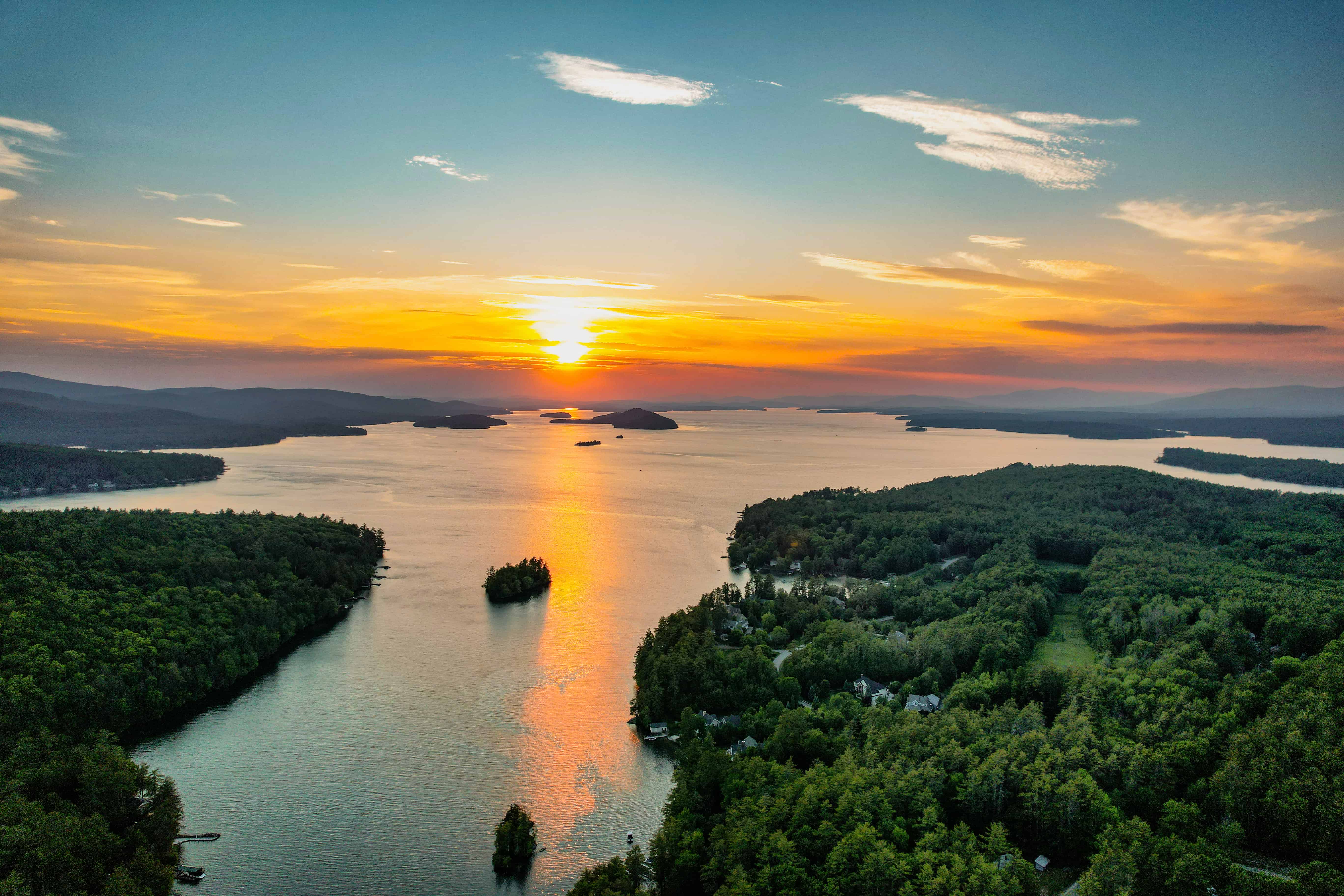




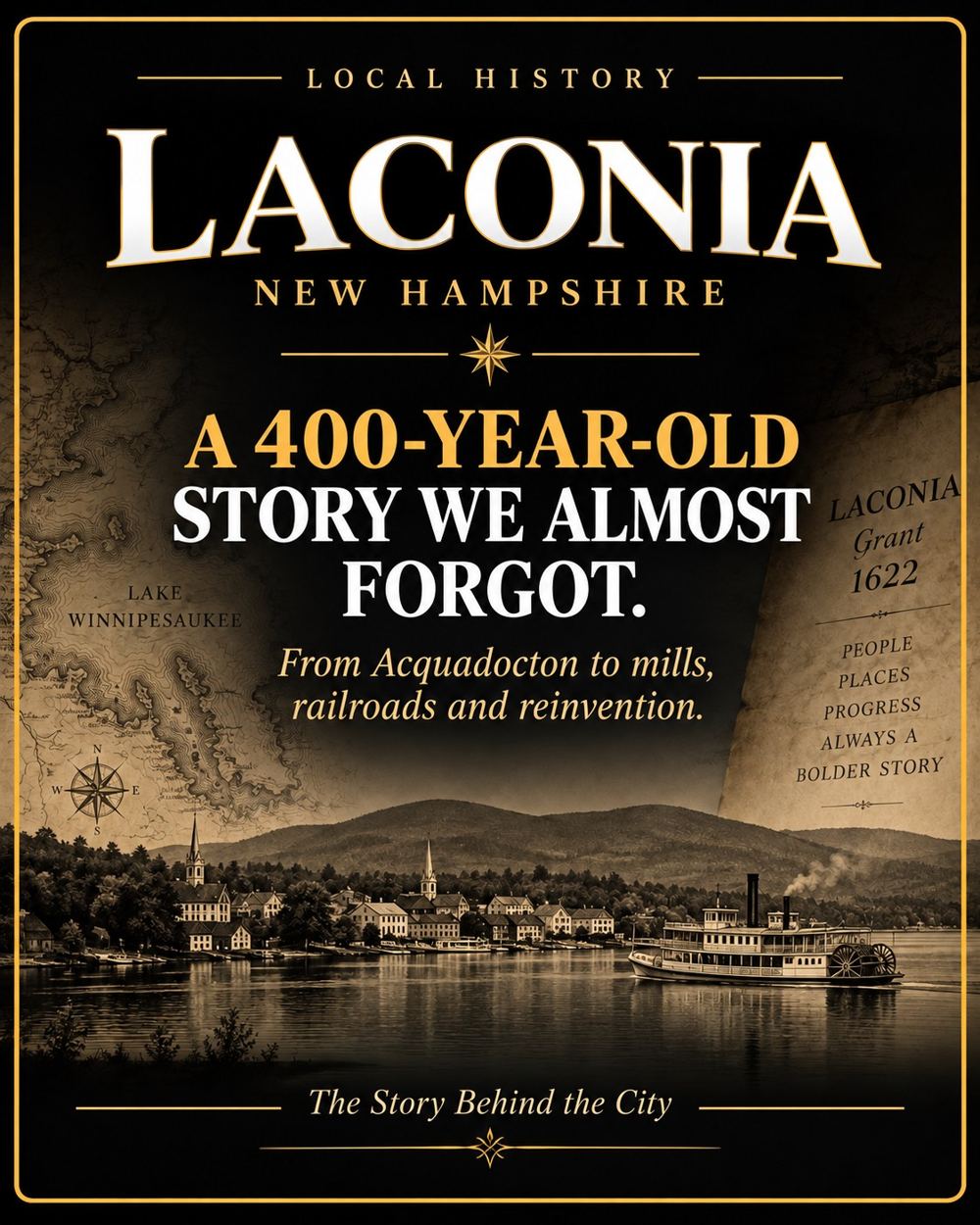
When people think of Laconia, New Hampshire, they often think first of Lake Winnipesaukee, Weirs Beach, boating and summer tourism.
That is certainly part of the story.
But Laconia’s history reaches much further back, and the city that exists today was shaped as much by Indigenous settlement, waterways, mills, manufacturing and railroads as it was by tourism.
Understanding that history helps explain why Laconia feels so different from many other communities in the Lakes Region.
Before There Was a City
Long before the modern City of Laconia existed, the area was already important to the Indigenous people who lived and traveled throughout the region.
The area around what is now Weirs Beach was home to Acquadocton Village, one of the region’s most significant Indigenous settlements. The narrow channel between the lakes was particularly important for fishing, and the name “Weirs” itself reflects the woven fishing structures used there.
European exploration and land claims followed during the seventeenth century.
The name Laconia is associated with early colonial land grants covering a far larger area than the present-day city. Those grants reflected the ambitions of English investors and settlers attempting to establish communities throughout northern New England.
The modern city would not emerge for more than a century.
Meredith Bridge and the Beginnings of Settlement
Permanent European settlement in the area began in the eighteenth century.
The settlement that developed around what is now Downtown Laconia became known as Meredith Bridge.
Its location was no accident.
Waterways were transportation routes, but they were also sources of power.
By the 1760s, mills were already operating in the area, using moving water to process lumber, grain and other materials. Over time, manufacturing expanded and became central to the local economy.
The rivers and canals that now contribute to downtown Laconia’s character were once part of a working industrial landscape.
Water Built the Economy
During the nineteenth century, Laconia grew into an important manufacturing center.
Textiles, machinery and other goods were produced locally, and the city’s waterways powered much of that activity.
The Belknap Mill remains one of the most visible reminders of this period. Built in the early nineteenth century, it stands today as a surviving link to Laconia’s industrial past.
That industrial history is important because Laconia did not develop simply as a resort community.
It was a place where people worked, built businesses and raised families long before lake tourism became a major part of the regional economy.
The Railroad Changes the Lakes Region
Rail service reached the area in the nineteenth century, dramatically changing both commerce and travel.
Goods could move more easily to larger markets, and visitors could reach the Lakes Region more conveniently.
Tourism expanded.
Hotels, steamships and summer travel became increasingly important, particularly around Weirs Beach and Lake Winnipesaukee.
Laconia gradually developed two identities at once.
It remained an industrial and commercial center while also becoming a destination for recreation and tourism.
That combination still defines much of the city today.
Laconia Becomes a Town, Then a City
Laconia was incorporated as a town in 1855, bringing together communities including Meredith Bridge, Lakeport and the Weirs.
It became a city in 1893.
Those separate beginnings help explain one of the most distinctive things about Laconia today.
The city does not feel like a single village that gradually expanded outward.
Instead, it is made up of several areas that developed with strong identities of their own.
Downtown Laconia, Lakeport and Weirs Beach remain distinctly different in character, architecture and relationship to the water.
Lakeport: Industry, Fire and Rebuilding
Lakeport developed as an important industrial community in its own right.
Mills, transportation and manufacturing helped shape the area, while nearby Lake Opechee and Paugus Bay influenced both industry and settlement.
In 1903, a devastating fire destroyed much of Lakeport.
The community rebuilt.
That pattern of change, loss and reinvention appears repeatedly throughout Laconia’s history.
Tourism Takes a Larger Role
As manufacturing changed during the twentieth century, tourism and service industries became increasingly important.
Weirs Beach became one of New Hampshire’s best-known visitor destinations.
Lake Winnipesaukee drew seasonal residents and vacationers.
Motorcycle Week became one of the region’s signature annual events.
Yet even as tourism expanded, Laconia continued to function as something many Lakes Region communities are not: a true year-round city.
It remained a center for government, healthcare, business, housing and services.
A City That Continues to Evolve
Today, reminders of Laconia’s past remain visible throughout the city.
Historic mills stand beside modern businesses and residences.
The restored Colonial Theatre has returned cultural activity to downtown.
Former industrial areas have found new uses.
Waterfront once valued primarily for transportation and industry is now prized for recreation, views and residential living.
And the communities of Downtown, Lakeport and the Weirs continue to evolve in different ways.
That history matters for anyone considering living in Laconia.
The city’s neighborhoods were shaped by different eras, industries and relationships with the water. As a result, housing, architecture, traffic patterns and lifestyle can change significantly within only a few miles.
The Story Behind the City
Laconia is often described through its lakes.
That makes sense.
Water has shaped the city for centuries.
But the fuller story includes far more.
Indigenous settlement.
Colonial land grants.
Mills and manufacturing.
Railroads.
Steamships.
Tourism.
Fire.
Rebuilding.
And continual reinvention.
The result is a community that does not fit neatly into one category.
Laconia is part historic mill city, part lake community, part tourism destination and part regional service center.
That complexity is not incidental.
It is the story of the city.
Thinking About Making Laconia Home?
Explore current homes for sale in Laconia through Maxfield Real Estate and see what’s available across the city’s very different neighborhoods and lake communities.




.png)


Footer Social Links